“I’d like to think we bring so much from the research side into our client projects that, even when research isn’t the topic, clients still get a view shaped by the latest science.”
Few technology companies have their own research institute. Cybernetica does. Our Information Security Research Institute (ISRI) is home to researchers working on secure computation and data privacy, alongside project managers who turn that expertise into results for clients.
To find out how these two worlds work together, we spoke to two people from opposite sides of the institute: Pille, a researcher, and Birgit, a project manager. They talked about deadlines, rabbit holes, misunderstandings and what it would be like to swap jobs for a day.
The interview
How would you explain what the Information Security Research Institute does to someone at a family gathering?
Birgit: Usually, when someone asks, I quickly change the subject, because it feels far too complicated to explain! But if I really make the effort, I’d say that, on the one hand, we build secure software that protects the data collected about people. On the other hand, we have many researchers working on the same theme: how to process data securely, so that information about you or me doesn’t end up in the wrong hands.
Most technology companies don’t have their own research institute. From where you sit, what does having one make possible for Cybernetica?
Pille: Research projects give us the chance to explore and experiment in territory where the process, the experimenting and the learning matter more than the outcome. Together, we can discover the new and exciting things that would move our products or clients forward. We can stay at the cutting edge, or even a little ahead of it.
What does your role involve, and what does a typical week look like?
Birgit: I’ve always said that I’m a bit of a juggler. On the one hand, I make sure our clients’ and partners’ wishes are reflected in our projects. On the other, I make sure everyone in our own team understands what they need to do and knows the project’s goals and timeline. Our team members matter most to me: it’s important to keep motivation and spirits high. To help with the latter, my fellow project manager Sandhra and I have organised team events for our department. I also prepare tenders, carry out internal audits and help with recruitment.
Pille: I’m not sure I have a typical week – even many of my regular meetings are fortnightly. My work involves a lot of reading, learning, thinking, discussing and writing. It’s all collaborative, but often I spend a longer stretch tinkering with a topic on my own before sharing it. We collaborate both within Cybernetica and with external partners, and sometimes that means travelling for meetings. There are always longer-term plans, but unexpected things keep popping up too: something to review, or a new paper that changes the direction of my work.
How do research and client projects connect at the institute? Is there a clear line where one ends and the other begins, or is it messier than that?
Pille: For most projects, you can probably draw the line on paper: which kind it mainly is, and whether the funding comes from a research grant or a client. But when you look at how people move between projects, I don’t think the line is that clear in terms of knowledge. I’d like to think we bring so much from the research side into our client projects that, even when research isn’t the topic, clients still get a view shaped by the latest science. And client projects certainly inspire us on where to take our research next.
Birgit: They’re connected through people, as client projects often need a data scientist or a privacy technology expert on the team. By nature, though, the projects are quite different. Research projects last longer and are mostly funded by the European Commission, the European Defence Fund or the Estonian Research Council. Commercial projects for public institutions and private companies are shorter and more intense.
What do you need from colleagues on the other side to do your job well?
Birgit: Openness and honesty. When everything’s going well, people find it easy to communicate anyway. You recognise a good colleague when things aren’t going as well as you’d hoped. Those situations take courage: a willingness to push your boundaries, to step outside your comfort zone for a while and to put things right. Luckily, that’s exactly what I’ve found at Cybernetica, and it’s a big part of why I enjoy working here so much.
Pille: Well-defined tasks or questions, and help spotting open problems. And some filtering, so that I’m brought in where my knowledge is genuinely useful.
Where do the research and commercial sides most often misunderstand each other or see things differently? And how do you find common ground?
Birgit: A researcher is driven by a scientific spirit that fuels their curiosity and motivation to dig deep into their field. Sometimes they’re so immersed in their topic that there’s little time or appetite left for business and financial matters. At other times, the business side needs to move faster and less thoroughly than suits a researcher. That’s where misunderstandings can arise. The best way to resolve them is still to sit down at the same table and have an honest conversation.
Pille: I haven’t actually come across many big misunderstandings – I suppose we’re used to working together. Perhaps the difference is that a client needs something specific delivered, whereas in research you can explore more and see where you end up. But when it comes to meeting deadlines and requirements, I think we’re equally diligent, whether we’re delivering to clients or to research projects.
What kind of person tends to click with the institute? Does research call for the same kind of person as client projects?
Pille: Someone curious and thorough, and open to challenges. Then again, client projects need the same qualities to keep Cybernetica’s flag flying high. In research, though, the end goal is often more open: you can follow your instincts and, if you like, go down an interesting rabbit hole. In client projects, you need to hold a very clear line so the result is exactly what the client needs. They also tend to have more schedules and structure, which takes more skill in wrapping things up once they’re “good enough”.
If you could swap roles with each other for a day, what would you most want to see or try?
Birgit: I’ve always felt that people with a PhD can grasp different topics faster and more broadly, as if their brains work differently and process information more quickly. I’d love to experience what it feels like to be as clever as Pille!
Pille: That actually sounds a little terrifying! It would be useful to see how she keeps track of so many different projects, clients, deadlines, requirements, unfinished tasks, upcoming events and everything else, so that it all gets done on time. But it seems like so much responsibility that, if I actually had to do it, I’d probably crawl under the desk straight away and say I don’t want to, I don’t know how and I can’t. Outside work, I’d probably try finding out what it feels like to whizz down a snowy slope.
How do you like to unwind outside work? And does your way of switching off say anything about your role at the institute?
Birgit: I love working out. In winter, I’m a big winter sports fan and work weekends as a ski and snowboard instructor at the Kuutsemäe ski centre. My need to keep moving is probably best reflected in the department team events Sandhra and I organise. We always include something physical, and the winter before last, I gave ski lessons at Kuutsemäe to anyone who fancied one.
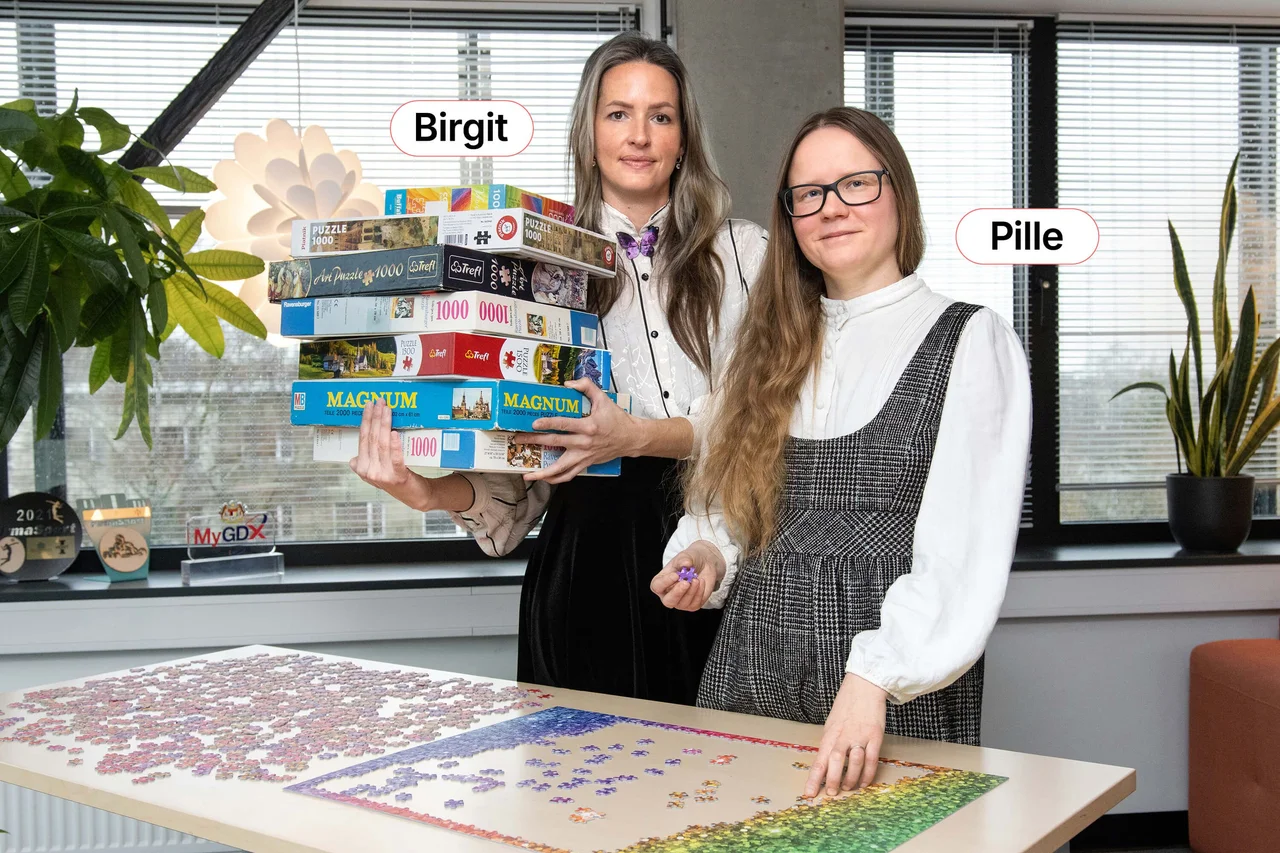
Pille: I like to keep moving: walking, being out in nature, running and cycling. I also enjoy reading, doing jigsaw puzzles and solving brain-teasers. The books and puzzles definitely reflect my work. Research is largely about reading, then fitting the pieces together into a new shape that works for you.
Finish the sentence: “Many people think [researchers / project managers] ___, but actually…”
Pille: Many people think researchers know a lot, or even everything, but actually, researchers are the ones who come up with good questions and love the hunt for the answers.
Birgit: Many people think project managers are big bosses who order everyone around, but actually, we work on projects together with the team and all steer the ship together.