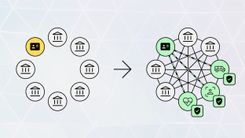
Every day, citizens interact with government services. Renewing a driving licence. Accessing healthcare. Filing taxes. And far too often, each interaction means submitting the same information all over again, to a department that has no idea what another has already approved.
Interoperability solves this by letting systems communicate securely and instantly, and it is already transforming how governments serve their citizens.
The problem with data silos
Most government organisations were built to operate independently. Each department runs its own systems, maintains its own databases, and has little visibility into what sits elsewhere across government. These are commonly referred to as data silos, and they are not a design flaw so much as a legacy of how public institutions were built. But they create a fragmented experience that frustrates citizens and government workers alike.
For citizens, it’s a relentless cycle:
- Apply for a benefit and submit details.
- Renew a license and submit them again.
- Access healthcare and start from scratch.
This is not just inconvenient. It is also costly, error-prone, and weakens trust in public institutions.
For government workers, the challenges are equally frustrating. Without real-time data verification between departments, every request becomes a bureaucratic maze. Staff spend hours verifying information that already exists elsewhere in government systems, leading to extended processing times, manual checks, and delays.
The cost of these silos extends far beyond inconvenience:
- Duplicate data entry multiplies the chance of errors.
- Outdated information often leads to poor decisions.
- Citizens lose confidence in their government's ability to serve them effectively.
These are known challenges, and interoperability addresses them directly.
What is interoperability?
Interoperability enables independent information systems to exchange data and share information seamlessly. Instead of building expensive custom integrations for every single connection, organisations can verify and share data in real time while maintaining full control over their own information.
For government services, this approach powers the "once-only" principle: citizens provide their information once, and government systems can access it whenever needed. No outdated copies. No duplicated databases. No discrepancies. Just up-to-date data, pulled directly from the source.
How government interoperability works
Leading interoperability platforms use a decentralised approach. Rather than funnelling all data through a central hub, they let organisations request data directly from each other through a network of secure gateways.
Each ministry or agency stays in control. They decide who accesses their data, when, and under what conditions. Every organisation connects through its own security server, which authenticates, timestamps, encrypts, and logs every request.
All outgoing data is digitally signed. All incoming data is authenticated. This creates an unbreakable chain of trust with complete transparency and accountability.
Free from a central bottleneck, this architecture delivers two key advantages:
- No single point of failure. If one system goes down, others continue operating independently.
- Guaranteed accuracy. Data is pulled directly from its authoritative source, ensuring organisations always get the most current information available.
Benefits of interoperability
Through its unique architectural approach, interoperability creates a resilient digital ecosystem. Services operate independently while remaining connected. This means that downtime at the tax agency for example doesn't affect a citizen's ability to renew their driving licence.
Beyond resilience, the transformation is comprehensive:
- Improved efficiency through automated data flows that eliminate duplicate entry.
- Enhanced collaboration as departments access information without bureaucratic delays.
- Better decision-making with real-time visibility across the entire network of organisations.
- Easier scalability as new services plug into existing architecture.
- Reduced costs through eliminated redundancy and lower maintenance overhead.
- Fully paperless operations, thanks to legally binding digital assurance and audit-ready evidence.
The result? An ecosystem that doesn't just survive disruptions; it actively enables better public service delivery at scale.
Challenges of interoperability
The case for interoperability is strong. But building it is not without its difficulties.
Legacy systems present significant technical barriers. These ageing platforms often lack modern APIs, store data in incompatible formats and resist integration without expensive custom development.
Then there's the political challenge. Full benefits take years to materialise while certain costs are incurred at the outset, even if decentralised deployment allows for the system to grow gradually. As a result, new governments may shift their focus to more visible projects, leaving digital transformation incomplete.
Standardisation faces pushback from agencies with different priorities, cultures, and existing workflows. Each department has invested in its own systems, and as a result, reaching an agreement is often a complex negotiation process.
Privacy and public trust may be the most sensitive issue of all. People worry about how their data is used and whether it is safe. Regulators find it hard to keep up with fast-moving technology. Building the legal frameworks and transparent governance needed to maintain public trust is an ongoing commitment, not a one-time task.
None of this is impossible to work through. Organisations that do navigate it successfully unlock improvements that far outweigh the upfront effort.
Government interoperability in action
The benefits and challenges outlined above are not only theoretical. Governments have been building and running interoperability infrastructure for over two decades, and the results are well documented. Here is what it looks like in practice.
X-Road: Estonia
Estonia’s X-Road has been the pioneering example since 2001, and remains the reference point for governments around the world.
X-Road connects nearly 1000 public and private organisations, powering more than 3000 digital services. It has become the backbone of Estonian digital society, processing more than 3.7 billion transactions every year. For a country of 1.37 million people, that is transformative.
It has also proven exceptionally resilient. Virtually no downtime since launch, and a security framework that has held firm against repeated large-scale cyber attacks in one of the most cyber-attacked countries in the world.
Cross-border interoperability
One of the most exciting new frontiers is cross-border interoperability. In 2018, Estonia and Finland connected their national data exchange systems – the first countries in the world to achieve this.
This matters because over 100 000 people commute between the two countries. Now, population data, business registries, and tax information can flow seamlessly across the Gulf of Finland. A Finnish resident working in Estonia can have their tax situation handled automatically. A business can verify credentials across borders in real time.
And others are following. The European Union is now developing broader interoperability frameworks to enable similar connections across all member states – a vision of truly connected European digital government.
Beyond government: private sector integration
Interoperability platforms aren't limited to government-to-government exchange. In Estonia, two-thirds of organisations connected to X-Road are private companies, including banks, telecommunications providers, and utility companies, among others.
This public-private integration accelerates adoption. When Estonia's two main banks switched from pin codes to digital identification through the platform, online government service usage jumped from 3% to nearly 40% within eight years.
Today, 99% of all government interactions in Estonia are conducted online, with 100% of services available digitally.
Unified Exchange Platform (UXP): The next chapter
The success of X-Road led to a next-generation solution: the Unified eXchange Platform (UXP), developed by Cybernetica, the same company behind architecting X-Road.
UXP was built for international deployment, drawing on nearly two decades of operational experience while adding stronger security and the capacity to scale for much larger populations.
Today, UXP powers interoperability platforms across more than ten countries on four continents. And while no two deployments are the same, each one demonstrates what the platform is capable of.
Global implementation of UXP
Perhaps the most compelling example is Ukraine. Trembita, the national interoperability platform built on UXP, supports the Diia app and delivers wide-ranging digital government services to millions of citizens. It has done so through ongoing conflict and relentless cyber attacks, remaining stable and operational throughout. Few platforms anywhere in the world have been tested under those conditions. Trembita has held firm.
Benin tells a different kind of story. Starting from scratch, with no existing digital government infrastructure to build on, UXP enabled a full national platform to be established and new public services to go live within a single year. In Malaysia, MyGDX platform uses UXP to connect a broad ecosystem of federal agencies, bringing seamless, secure data sharing to one of Southeast Asia's largest government networks.
The reach extends further still. Tunisia, the Bahamas, Greenland and Namibia have all adopted UXP-based solutions. NATO member states have piloted the technology through the Secure Digital Military Mobility System (SDMMS) consortium, using it for secure data exchange across coalition forces.
The future of digital government
Interoperability is about creating seamless, secure, and efficient connections between government services – connections that respect data ownership while dramatically improving the citizen experience.
Interoperability platforms are increasingly understood as core Digital Public Infrastructure (DPI) – alongside digital identity systems and digital payment rails. Together, these form the foundation of modern digital government.
In a world where we expect instant responses from commercial services, government services can now deliver the same level of responsiveness. The technology exists. The models are proven. The benefits are clear. And interoperability makes it possible.
If you are ready to explore what interoperability could mean for your government, our team would be glad to help you take that first step. Reach out to start the conversation.